Tuesday, March 26, 2013

How to Juggle

When I was on the cruise ship my family and I went to a workshop to learn how to juggle.  The person teaching the workshop was Michael Holly.  He learned how to juggle in college when his friend showed him how to do it.  He has made a career out of juggling.  I will share the steps that he showed us and also give you the link for his website so you can learn how to juggle yourself.  I am getting better with 2 balls but still have not mastered 3.


The first step is to not even use any juggling balls. It is just to make a figure 8 (infinity symbol) in the air with your right hand first and then with your left hand.  This helps you to help your brain learn about the pattern that the juggling balls make in the air.


The next step is to use one ball and practice throwing it in the air from one hand to the other.  You do not need to throw the ball high up in the air because juggling is just small throws in front of you.


The third step is to use 2 juggling balls.  Start by throwing the ball in your left hand first followed very shortly after by the right one.  Try to get a rhythm going and picture the figure 8 pattern that you first practiced.  Even 2 balls can be challenging to catch.
 
 
Before you try to juggle 3 balls it is good to practice just throwing them up in the air and letting them land without catching them.  This gives you a feel for the pattern.  Start with 2 of the balls in your left hand and throw one of them in the air to the right hand.  Before you can catch it you have to throw the ball in your right hand to the left.  Before you can catch that one you have to throw the ball in your left hand to your right hand.  The whole act of juggling moves very quickly.
 
Here is a picture of  Michael Holly and his link is michaelholly.com  He suggests practicing on your bed or couch so that the juggling balls don't bounce away too far.  He also says that you can practice in your living room when commercial breaks are on.  He says that anyone can learn to juggle.  When Michael was a kid his mom took him to the doctor because he did not have good coordination but look at what hard work and dedication did for him!


Monday, March 25, 2013

Shells and Beach Things

During my time here I have gone to the beach many times and I have seen lots of cool things.  I will share some of the things I have found. 


Here is a photo of a fossil shark tooth. I found at Fort Meyers Beach.  This tooth could be millons of years old.


This is an olive shell. Seashells are actually the skeletons of mollusks (snails, clams, oysters).  They grow their skeletons on the outside of their body instead of on the inside like you or me. 


This is an abilone shell.  It  is very shiny.  Shells help protect the sea creatures from other animals, strong currants, storms and help hide the creature.


This a starfish but is not really a fish. It does not have gills, scales or fins.  They do not move with tails.  They have little tube feet to help them move.
 
 
This is a sand dollar.  It was once alive.  It moves around with tiny little feet on the outside of it.  The little round circle in the middle of it is its mouth.  It eats zooplankton and algae.


This is a conch shell.  You say the word "conk".  Some of these shells get really large.  When we went to a restaurant I ate conch fritters which is really the mollusk in the shell which is deep fried.


This shell is called a flat tellin.  It is a "bivalve shell" because it has 2 sides to it and probably at one time had an oyster or a clam living in it.  When the creatures living in the shells get too big for the shell they will leave and look for another larger shell to live in. 
 
 
Also one day I saw a dolphin swimming close to shore.  It might have been a Bottlenose dolphin which are common in Florida.  It was by itself but they often travel in pairs or in groups.

Sunday, March 17, 2013

Blue Jays against Red Sox game

A couple of days ago we went to a Blue Jays spring training game against the Boston Red Sox.  The Red Sox train at Jet Blue Park in Fort Meyers. The ballpark is neat because it it very new and in the outfield they have a mini "Green Monster" wall just like they have in the real Fenway Park stadium in Boston.  


I went to the game with my cousins Emma and Mia who were visiting for March Break. 
The game was fun because it was a close game. The Jays did not win but they almost came back at the end of the game. Jose Bautista was playing in the game and did well.  The cool part was that after the game we went to where the Blue Jays walk out of their change room and get on to their bus. The Jays centre fielder Colby Rasmus stopped and signed a baseball for us. 


Here is a close up of the signed baseball.
 
We are going to a Minnesota Twins and Blue Jays game next Sunday and maybe I wil be lucky enough to get another autograph.

Thursday, March 7, 2013

Manatees

Manatees
 
We went to Manatee Park.  It is in Fort Myers.  There is a river there that the manatees like to come to when the weather is cold.  The water there is warm because there is a hydro plant there that lets off warm water into the river. 
 
We saw five manatees at least. Manatees are relatives to elephants. They are mammals. Manatees weigh 800 to 1200 pounds. Manatees can hear from far away. Manatees usually stay to the surface of the ocean because they need air to survive. A manatees mouth and flippers are the like the elephants. Manatees eat sea grass, marina algae, turtle grass, alligator weed, water lettuce and musk grass. Manatees live alone the only relationship it has is with his or her mother. They live with their mother for 1-2 years after birth.
 
 
 Manatees are an endangered species. They are endangered because of the limited food supply and how humans have treated them.  Years ago, humans hunted Manatees for food, and oil. It is illegal to hunt Manatee but many Manatee are killed by boats.  In Florida, it is law to slow down in known Manatee areas and there is even a Save the Manatee Club. If you interested check out www.savethemanatee.org/


Monday, March 4, 2013

Cape Coral

In Cape Coral Florida I am staying in a house we rented for 6 weeks.
Here are some things I have seen at my house: An alligator, Burrowing Owl, A carp (which is a fish), Turtles, Geckos, Ducks, An osprey (a big eagle) and more.  I also had a close encounter with a Snake which I thought it was a Pygmy Rattle Snake.
 
One day my Dad and I were fishing in the canal in our backyard when we saw a small alligator swimming. He came and bit my bobber and then went to my Dads hook but luckily he shook it out of his mouth.
 This is the bobber that now has teeth marks in it.
 
We have done lots of fun things around here so far.  We went to Sanibel Island, the World’s largest shell factory, Lakes Regional Park (where we rented bikes and had an alligator cross in front of us on the road), roller skating at a place called Bamboozles, and explored an island near us called Pine Island.  We also biked to a sports park that is near our house.  It has 5 soccer fields and 9 baseball fields.  We played some soccer there.  Today we might go back there to play some baseball.


Wednesday, February 27, 2013

St. Thomas U.S. Virgin Islands

On the cruise we stopped at St.Thomas in the U.S. Virgin Islands.  It was a beautiful island.
 
Christopher Columbus landed on the island in 1493 and he named it Santa Cruz. It also used to be owned by the Dutch to grow sugar cane. It was a place that pirates used to go to. We got a taxi. It was a cool taxi because we sat outside in the taxi.  Our drivers name was 10-10.
 
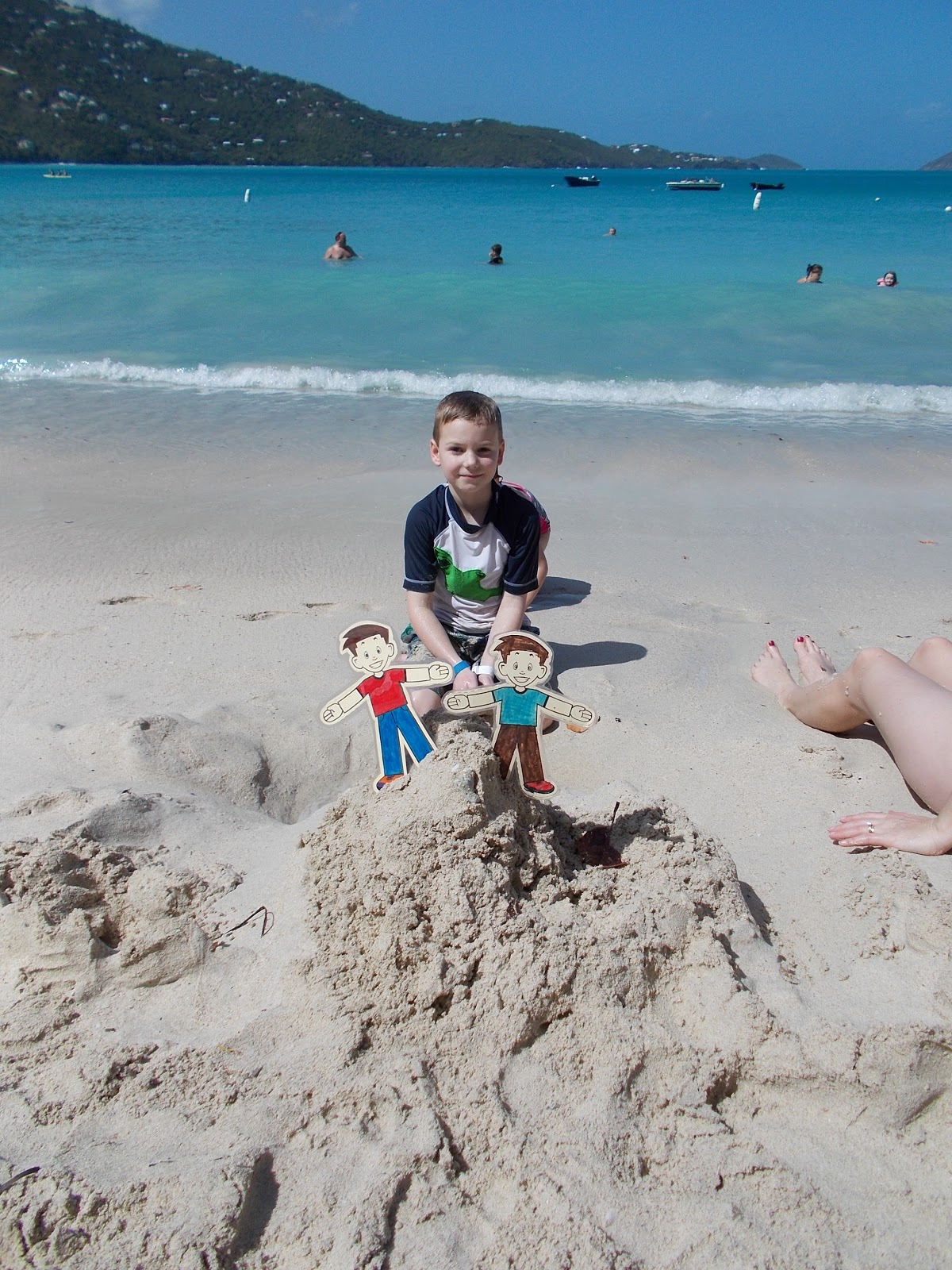
We went to Magens Bay which is a beach. It is known as one of the nicest beaches in the world.  I went swimming and I built a sand castle and a moat that I could go in.
 
There are about 50 000 people who live on the island.  Their main language is English and they buy things with the U.S. dollar.  It is kind of strange because they drive on the left side of the road.  They are 1 hour ahead of us because they are so far east of where we live.  I really liked all the great views I saw when I was on the island.
 
At night we had a pirates night because of all the pirates that used to be in this area.


Tuesday, February 26, 2013

San Juan Puerto Rico

San Juan Puerto Rico has deserts, rain forests, caves and wild cats running around. I forgot to mention it also has forts. Ponce De Leon founded the city in 1508.
 
If you don`t believe me about the cats look at this photo. The population of the old part of the city is 18,000. We were there on Ash Wednesday when people wear ashes on their heads. There was an Ash Wednesday service on the ship.  
  
This is Castillo de San Cristobal. It was built in 1783. The fort was made to protect the city.
Puerto Rico has many beautiful buildings and nice shops with homemade items.
Below are some photos of the city that I like.


This is a grave yard. 


Friday, February 22, 2013

Castaway Cay

On the Disney cruise we stopped at Castaway Cay. Castaway Cay is 1 of 700 islands in the Bahamas. Its located near Great Abaco island. Also known in the story of Castaway Cay, a group of castaways went to the island in a small boat. When they got there they started to dig. They believed there was treasure on the island. Days went on then one day they didn't think there was treasure on the island because there was nowhere else to dig. They made a plan to escape in the night there was a storm in the morning and their boat was  gone... or so the story goes

This is what it looks like after Hurricane Sandy.
 
 
This the adult beach.
 
 
We went snorkeling.  We saw a sunken submarine, a Mickey statue and parrot fish and angel fish.
 

Wednesday, February 20, 2013

Ship facts

The Disney Fantasy cruise was Amazing! The ship was ordered, Feb. 22, 2007. It cost 900 million Dollars. The Disney Fantasy is almost the same as the Disney Dream. It was built in Germany. It is 42 m [ 137 ft 10 in] from side to side.

It has 1250 staterooms sleeping 4000 passengers and 1450 crew members.  The ship even includes the worlds first aqua duck water rollercoaster which I went on 8 times. The ship includes an "arr-cade", ice-cream bar, broadway theater, movie theater, the D-lounge, discos, many pools, mini golf, ping-pong, basket ball courts, many stores, including the Bibbity Bobbity Boo shop, an interactive detective game, an art gallery, shutter fly photo lab many restaurants, and every Disney character you can imagine!  Wow, we were entertained!!

Sunday, February 17, 2013

Orange Juice Museum

We went to Florida’s Natural orange museum.  We learned that 1000 orange groves with 50 000 acres of orange trees provide oranges and grapefruits for Florida’s Natural orange juice factory.

Here are millions of oranges waiting to be sorted and squished.
 
 
An orange seed is planted and it grows for a year this is called “root stock” this tree then goes to a nursery where a bud is grafted to it from another established tree or “parent tree”. The tree then grows for another year and it is ready to be transplanted into a grove.
Orange trees are full grown at 25 years and have up to 2000 pieces of fruit. Do you know that a grafted tree can start producing fruit at 3 years of age.  Can you believe that a citrus tree can bear fruit and live for 100 years or more.  The fruit must stay on the tree until it is ready to eat because once you pick an orange it does not ripen like an apple or a banana.
 
 
Here is a picture of Grace and me in front of a Valencia tree.  These trees are used most often for juicing.
 
This is a picture of an orange grove near my Grandpa's place.
 
 
This is a picture of an orange juicer that they use to squeeze all the juice out.
 
.  At the museum I got to sample many kinds of juice I have decided that Florida’s Natural is the best juice because it is only juice and no water is added.  The pulp and peels are even made into shampoo, perfumes, cooking oils, animal feed, and furniture varnish. The company has even won awards for being an environmental friendly company they reuse and filter water for washing and watering their groves.
 
Oranges that are in season
 
Nov.-Jan.                                             Jan.                                                        Feb.
Royal Navel Oranges                      Honey Bells (very sweet)             Temple oranges (tangy, tart)
Ruby Red Grapefruit                      Ruby Red Grapefruit                      Ruby Red Grapefruit
 
 
Mar                                                        Mar.-June
Honey Tangerine                             Valencia (sweetest of the season)
Ruby Red Grapefruit                     
 
That is my day learning about oranges.